Producing Blocks
Figure 1 estimates the average block production rate for Cardano stake pools operating in the Mainnet environment, based on stake size.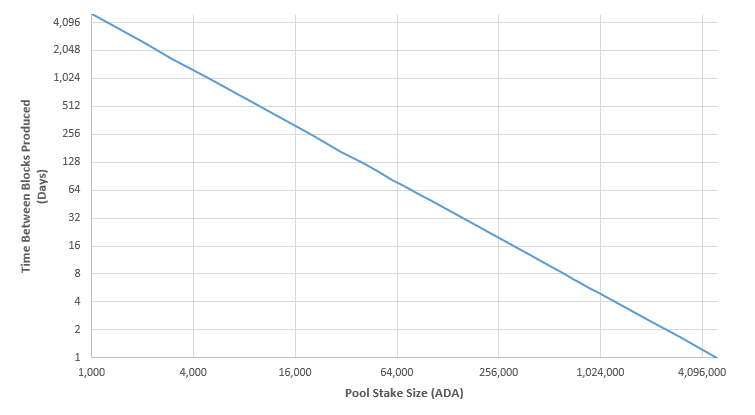
Log Entries Related to Block Production
When Monitoring the Cardano Node Log for the block producer in your stake pool configuration, the Forge.Loop.NodeNotLeader trace adds an entry for every slot when the stake pool is NOT elected to prepare a block. For example:
[cardanonode:Forge.Loop.NodeNotLeader](Info,94) Not leading slot 91529678
In a slot when the stake pool that you operate is elected to prepare a block, the log for the block producer includes timestamped entries that the Forge.loop.NodeIsLeader and Forge.Loop.AdoptedBlock traces add. For example:
[cardanonode:Forge.Loop.NodeIsLeader](Info,94) Leading slot 91529679
[cardanonode:Forge.Loop.AdoptedBlock](Info,94) Adopted block forged in slot 91529679: 081d7bd9bab008f9ac94223ea25bf1b75d4a79f7c222f81b74e72a282e9a6ceb
The Forge.Loop.NodeIsLeader log entry indicates that the local Cardano Node instance is preparing a block for the specified slot.
The Forge.Loop.AdoptedBlock log entry indicates that the Cardano network accepted the block that the stake pool prepared and submitted. Rarely, the network may need to reject a block after accepting the block. To confirm that a block is added to the Cardano blockchain ledger successfully, search for the block hash included in the Forge.Loop.AdoptedBlock log entry or the stake pool ID using a Cardano blockchain explorer.
Important | Stake pools only receive fees for prepared blocks that are successfully added to the blockchain ledger. |

Making Continuous Improvements
When the stake pool that you operate in the Mainnet environment successfully produces blocks, consider working towards implementing Recommended Mainnet Specifications.