Registering a Stake Address
In the Cardano ecosystem, you must register on the blockchain the stake address associated with a payment address containing funds that you plan to stake or pledge.
Therefore, you need to create a transaction registering the stake address associated with the payment address containing funds that you plan to pledge to your stake pool.
Figure 1 provides an overview of the process to prepare and submit a transaction using the Cardano Command Line Interface (CLI).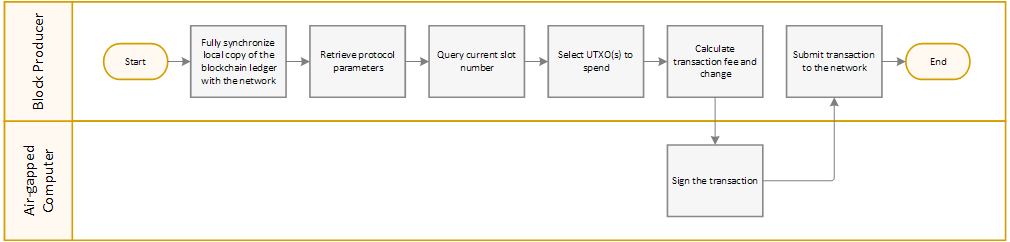
Note | Cardano CLI commands throughout the How to Set Up a Cardano Stake Pool guide may use the |
To register a stake address on the blockchain:
- On the block-producing node, using a terminal window type the following commands to save protocol parameters in a file using JSON format:cd $NODE_HOMEcardano-cli conway query protocol-parameters \--mainnet \--out-file params.json
- To retrieve the amount in Lovelace of the deposit required to register a stake address, type:stakeAddressDeposit=$(cat $NODE_HOME/params.json | jq -r '.stakeAddressDeposit')echo stakeAddressDeposit: ${stakeAddressDeposit}
- To create a stake address registration certificate, type:cardano-cli conway stake-address registration-certificate \--stake-verification-key-file stake.vkey \--key-reg-deposit-amt ${stakeAddressDeposit} \--out-file $NODE_HOME/stake.cert
- To query the slot number of the current tip of the ledger, type:currentSlot=$(cardano-cli conway query tip --mainnet | jq -r '.slot')echo "Current Slot: ${currentSlot}"
Note

The
cardano-cli conway query tipcommand uses theCARDANO_NODE_SOCKET_PATHenvironment variable that you set in the$HOME/.bashrcfile when Installing Shared Libraries.cardano-clicommands throughout the How to Set Up a Cardano Stake Pool guide may use theCARDANO_NODE_SOCKET_PATHenvironment variable. If you do not set theCARDANO_NODE_SOCKET_PATHenvironment variable or the environment variable is unavailable, then you need to set the--socket-pathoption explicitly in commands requiring the location of the Cardano Node socket file. - To retrieve the UTXOs available for your payment address and calculate the balance, type:# Retrieve the list of UTXOs available for your payment addressutxo_json=$(cardano-cli conway query utxo \--address $(cat $NODE_HOME/payment.addr) \--mainnet)# Initialize variablestx_in=""total_balance=0# Loop through the list of UTXOswhile read -r utxo; do# Retrieve the values for the current UTXOvalues=$(jq -r --arg k "${utxo}" '.[$k]' <<< "${utxo_json}")# Retrieve datum associated with the UTXOdatum=$(jq -r '.datum' <<< "${values}")# Retrieve the reference script associated with the UTXOscript=$(jq -r '.referenceScript' <<< "${values}")# If limits on spending the UTXO may exist, then skip the UTXOif [[ ${datum} == 'null' && ${script} == 'null' ]]thenhash=${utxo%%#*}idx=${utxo#*#}utxo_balance=$(jq -r '.value.lovelace' <<< "${values}")total_balance=$((${total_balance}+${utxo_balance}))echo "TxHash: ${hash}#${idx}"echo "UTXO Balance: ${utxo_balance} Lovelace"tx_in="${tx_in} --tx-in ${hash}#${idx}"fidone <<< "$(jq -r 'keys[]' <<< "${utxo_json}")"echoecho "Total available balance: ${total_balance} Lovelace"echo "Final --tx-in string:${tx_in}"
- To build a draft transaction for calculating the transaction fee, type:cardano-cli conway transaction build-raw \${tx_in} \--tx-out $(cat $NODE_HOME/payment.addr)+$(( ${total_balance} - 200000 - ${stakeAddressDeposit} )) \--invalid-hereafter $(( ${currentSlot} + 10000 )) \--fee 200000 \--certificate-file $NODE_HOME/stake.cert \--out-file $NODE_HOME/tx.tmp
Note
The
--invalid-hereafteroption sets the slot when the transaction expires. The above transaction expires 10,000 seconds—about 2 hours and 45 minutes—after the current slot. - To calculate the fee for the transaction in Lovelace, type:fee=$(cardano-cli conway transaction calculate-min-fee \--tx-body-file $NODE_HOME/tx.tmp \--witness-count 2 \--byron-witness-count 0 \--protocol-params-file $NODE_HOME/params.json | jq -r '.fee')echo "Fee: ${fee}"
Note
The
--witness-countoption indicates the number of keys signing the transaction. You must sign a transaction submitting a stake address registration certificate to the blockchain using the secret—private—key for the payment address spending the input, as well as the secret key for the stake address to register. - To calculate change from the transaction, type:txOut=$(( ${total_balance} - ${fee} - ${stakeAddressDeposit} ))echo Change: ${txOut}
Note
If change from the transaction is less than 1₳ then funds are insufficient. Transactions having insufficient funds fail when submitted to the network.
- To build the transaction, type:cardano-cli conway transaction build-raw \${tx_in} \--tx-out $(cat $NODE_HOME/payment.addr)+${txOut} \--invalid-hereafter $(( ${currentSlot} + 10000 )) \--fee ${fee} \--certificate-file $NODE_HOME/stake.cert \--out-file $NODE_HOME/tx.raw
- Copy the
tx.rawfile that you created in step 9 to the$NODE_HOMEfolder on your air-gapped, offline computer, and then using a terminal window type the following commands to sign the transaction:cd $NODE_HOMEcardano-cli conway transaction sign \--tx-body-file tx.raw \--signing-key-file payment.skey \--signing-key-file stake.skey \--mainnet \--out-file tx.signed - Copy the
tx.signedfile that you created in step 10 to the$NODE_HOMEfolder on the block-producing node, and then using a terminal window type the following command to submit the transaction to the network:cardano-cli conway transaction submit \--tx-file $NODE_HOME/tx.signed \--mainnet
Challenge | To display a draft, unsigned or signed transaction in a human-readable format, type the following command where |

Additional Resources
For more details on creating transactions, see Transaction Tutorials and Getting Started with Cardano CLI.